Reference · Reference: Credit Bureau Reference: Credit Bureau The pull the decision was made on: whose credit it is, which bureau it came from, the scores returned and the summary underneath them. Two people on a file means two credit pulls and two tiers — which is what the Borrower Profile then shows you. Come here to look up one term without walking the whole flow. Deciding without the co-applicant's pull is, per the implementation manager, the most common reason a decision has to be reversed. Further down the same page a Credit Summary reduces the report to the attributes Marine underwrites on, counting derogatory items and past due over a 36-month window, and Applicant Information sits beside it with the SSN and date of birth masked until you reveal them deliberately.
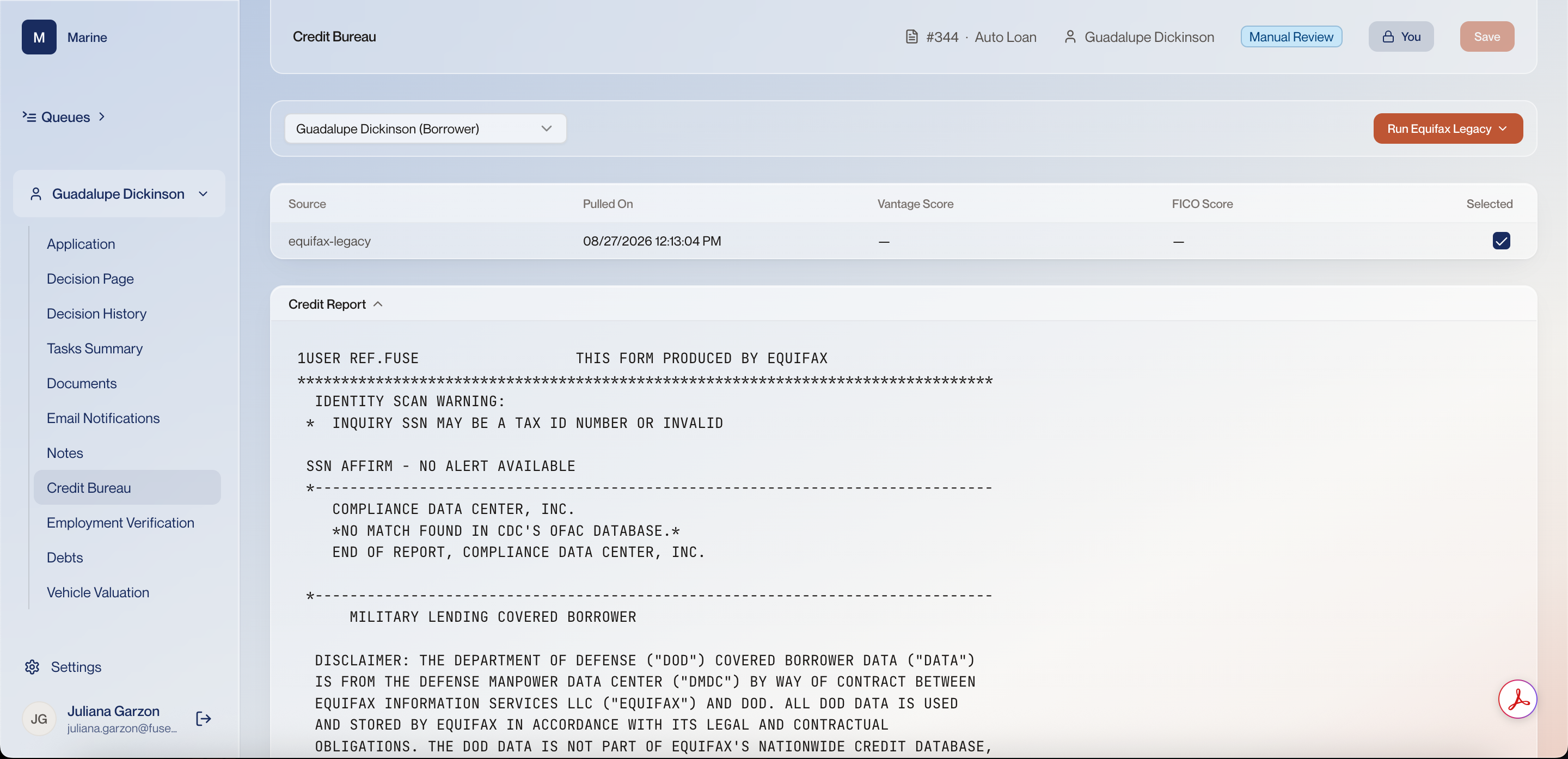
Credit Bureau 1 Person selector The dropdown reads “Guadalupe Dickinson (Borrower)”. Everything below it — the pulls, the report, the summary — belongs to the person named here. Open it to switch to the co-applicant and run theirs. Applicant and co-applicant are pulled separately. This control is the only thing that tells you which of them you are currently looking at. Watch out: A decision taken without the co-applicant's pull rests on half the file. On a joint application, open this dropdown, switch to the co-applicant and confirm their pull exists before you decide. 2 Run Equifax Legacy Runs a credit pull for the person selected above, from the bureau named on the button. Each press adds a row to the list below with its source and the moment it was pulled. Nothing pulls credit on its own here, and the applicant and the co-applicant are pulled separately. Every pull costs Marine money, so check the list before running another one. 3 Choosing who to pull, and from where Before you run a pull you choose two things: whether it is for the primary applicant or the co-applicant, and which bureau, where more than one is configured for the client. Applicant and co-applicant are separate pulls and separate charges, and the bureau you chose is on the record with the pull. 4 The pulls on this borrower One row per pull: source equifax-legacy, pulled on 08/27/2026 12:13:04 PM, with Vantage Score, FICO Score and a Selected column. An application can hold several pulls, so this table can run to more than one row. The timestamp is how you tell a pull taken for this deal from one left over from an earlier application, and each row in this table is a pull Marine paid for. 5 Vantage Score and FICO Score The scores returned by the pull. A bureau report can carry more than one scoring model, and the page shows each one separately with its name beside it. The score decides the tier, and the tier is what the rate and the approval hang on. Read which model you are looking at before you compare a score to a policy threshold. 6 Selected The page keeps the history of every pull with its score, and Selected marks the pull the deal is being read against. More than one pull can sit on a file. Selected is what tells you which score the rest of the page is using. 7 How a pull ages A credit report already pulled for the same applicant within the last 30 days is reused rather than pulled again. It keeps the client from being billed twice for the same report, so a recent pull is a reason not to run one. 8 Credit Report The raw bureau output, in full, exactly as Equifax returned it. It expands and collapses from the caret beside the title. When the summary and the file disagree, this is the source of truth you check against. 9 Identity scan warning On this pull the report warns that the inquiry SSN may be a tax ID number or invalid, while SSN Affirm returns no alert. An identity warning is about who the file belongs to, not about how they pay. It is worth resolving before the numbers matter. 10 OFAC check Compliance Data Center reports no match found in the OFAC database for this applicant. The sanctions screen rides along with the pull. Its result lives here, not on a separate page. 11 Military Lending covered borrower The report carries the Department of Defense covered-borrower disclosure, sourced from the Defense Manpower Data Center through Equifax. Whether the borrower comes back as a Military Lending Act covered borrower. The answer arrives inside the pull rather than from anything keyed on the application. 12 Credit Summary Below the raw report: a summary of the attributes this client asked to see — a simplified reading of what the full report contains. It opens with Scores and the FICO Score line. This is the bureau's attributes filtered to the ones Marine underwrites on. Which lines appear is configured per client, so another lender's Credit Summary will not look like this one. 13 Derogatory Items (36 mo) Unpaid judgments, public records, collections, liens and charge-offs, each as a count and an amount, with a total for both. The window is 36 months. Anything older than three years is not counted here, however serious it was. 14 Past Due (36 mo) Accounts past due, past due amount, and accounts not brought current — again over the same 36-month window. Accounts past due and accounts not brought current are counted as separate attributes, so read which of the two a number belongs to. 15 Applicant Information Beside the summary: borrower name, SSN shown as ***-**-4321, a masked date of birth and On File Since, each masked value with an eye icon to reveal it. Identifiers are masked by default and revealed deliberately. Uncovering one is an act, not a glance.